
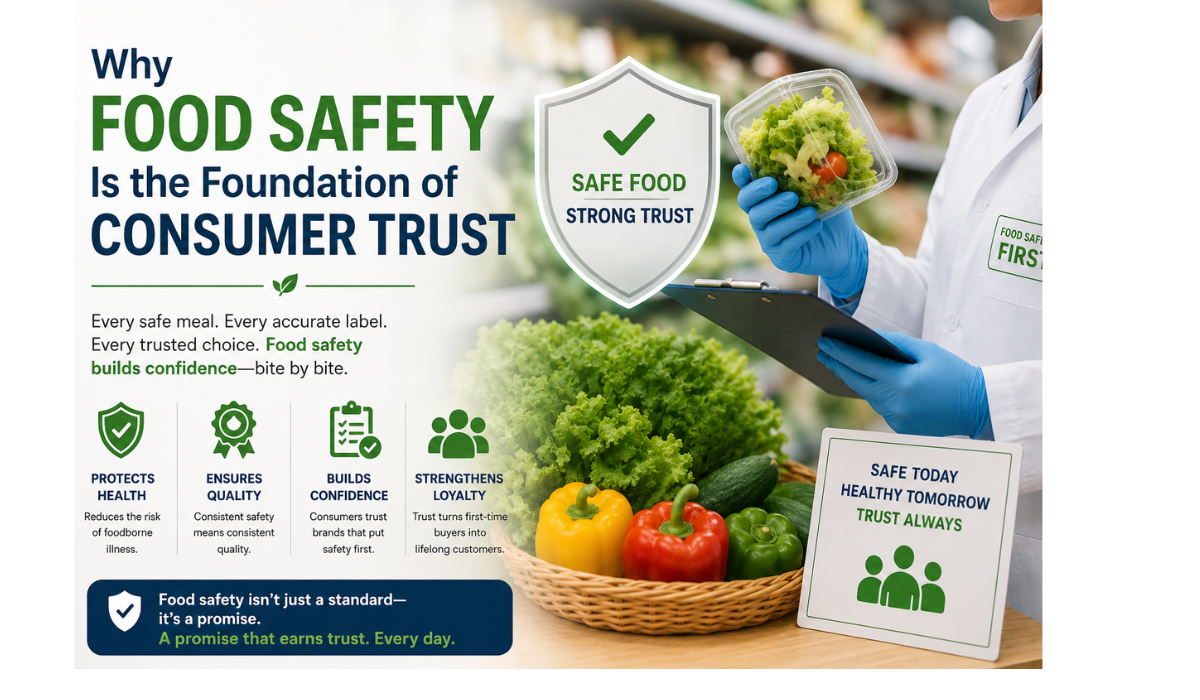
Building Trust Beyond Taste, Packaging and Labels
Food has always held a special place in people’s lives. It is connected to memories, traditions, family experiences and cultural identity. For many consumers, food choices are emotional as much as practical. A familiar taste can remind someone of home, a trusted brand can become part of a family routine, and a product purchased repeatedly can become a habit built over years.
Yet, when consumers evaluate food products, they often judge what they can immediately see. Packaging, branding, label claims, shelf presence, price and convenience all influence purchase decisions. These elements are important, but they do not define food safety. A product may look appealing, sound premium and carry strong claims, but true food safety is built much before it reaches the consumer.
Food Safety Begins Before the Product Reaches the Shelf
Food safety begins at the source. It is shaped by the quality of ingredients, the discipline of procurement, the reliability of suppliers, the standards followed in manufacturing, the care taken during storage and distribution, and the accountability shown by leadership.
In today’s food industry, safety is not just about meeting regulations. It is about building trust every single day.
As food businesses grow and supply chains become more global, the challenge of maintaining safety has become more complex. Ingredients may come from different regions, manufacturing may happen at scale, and products may travel across cities, countries or continents before reaching consumers. In such a layered system, even a small gap at one stage can affect the final product.
This is why food safety can no longer be seen as the responsibility of one department alone. It must be part of the entire value chain.
The Challenge of Consistency in Food Safety
One of the biggest challenges in modern food supply chains is consistency. A product that meets quality standards once may create satisfaction. A product that meets those standards every time creates trust.
Consumers expect the same taste, texture, freshness and quality whenever they buy a familiar product. If that experience changes frequently, confidence in the brand begins to weaken.
Consistency, however, does not happen by chance. It requires systems, discipline and control.
Strong Sourcing Creates the Foundation
The foundation of consistency lies in sourcing. The quality of a finished food product will always depend on the quality of its raw materials. If ingredients are inconsistent, unsafe or poorly handled, it becomes difficult to deliver a reliable final product.
Strong supplier relationships, defined specifications, traceable sourcing and disciplined procurement practices help reduce risks at the very beginning of the journey.
Process Discipline Makes Quality Predictable
Once ingredients enter the manufacturing process, the next critical factor is process discipline. Food production cannot depend only on individual experience or manual supervision, especially as businesses scale.
Every stage of production must follow clearly defined standards. Preparation, manufacturing, freezing, packaging, storage and transportation all need proper control.
When processes are repeatable, quality becomes predictable. When quality is predictable, consumers receive a more reliable product.
Technology Is Transforming Food Safety
Technology is playing an increasingly important role in strengthening food safety. In the past, many food safety interventions were reactive. Problems were often identified after they had already occurred. Today, technology allows food businesses to become more preventive and predictive.
Real-time monitoring systems help manufacturers track important production parameters such as temperature, humidity, processing time and equipment performance. Automated controls reduce human error and help maintain uniformity across batches.
Digital traceability systems allow businesses to track ingredients, production details and movement across the supply chain.
Traceability Helps Manage Risk Faster
Visibility across the value chain is extremely valuable. If a potential issue is identified, companies can act quickly, isolate affected batches, understand the source of the problem and take corrective measures. Faster action reduces risk and protects consumers.
Technology also helps companies learn from data. Consumer feedback, complaint patterns, production reports and quality trends can provide important insights. These insights help businesses improve products, strengthen processes and identify risks before they become larger problems.
In this sense, technology is not only an efficiency tool. It is a trust-building tool.
Leadership Sets the Standard for Food Safety
Systems and technology alone are not enough. Food safety also depends strongly on leadership.
The standards followed inside an organization are often a reflection of what leadership values and accepts. If leaders treat quality as negotiable, that attitude eventually affects teams and processes. If leaders consistently prioritize safety and consumer trust, the organization begins to reflect that commitment.
Food safety requires decisions that may not always be the easiest or most profitable in the short term. It may require rejecting a batch of raw material, investing in better systems, slowing down production to correct an issue, or training teams repeatedly until standards become a habit. These decisions protect the long-term credibility of a brand.
Consumer Trust Is Built Through Repeated Experiences
Consumers may never see the factories, laboratories, quality checks or audits behind a product. They may never know how many steps are taken to ensure safety. But each time they choose a brand, they place trust in it.
That trust is built silently through repeated positive experiences.
For this reason, food safety should not be treated as a back-end function. It is central to brand reputation.
Safety and Efficiency Must Work Together
Another important point is the relationship between safety and efficiency. Many businesses wrongly view rigorous safety systems as a barrier to operational speed. In reality, strong safety systems often make businesses more efficient over time.
Poor controls may save time temporarily, but they can lead to wastage, inconsistency, complaints, recalls and reputational damage.
A truly efficient food business is one where safety is built into everyday operations. When sourcing is disciplined, production is standardized, employees are trained, and technology monitors critical points, quality does not become an additional burden. It becomes part of the way the business runs.
Efficiency should not come at the cost of safety. It should come because safety systems are strong, predictable and consistently followed.
Consumers Now Expect Greater Transparency
The role of consumer awareness has changed significantly. Today’s consumers are more informed than ever before. They want to know not just what they are eating, but how it was sourced, produced and safeguarded.
Labels and claims are useful, but consumers increasingly expect brands to demonstrate transparency. They want assurance that the product is not only tasty and convenient, but also responsibly made.
This shift is pushing food companies to become more accountable. Traceability, transparency and consistency are becoming important differentiators.
Brands that can show stronger control over sourcing, manufacturing and quality management will be better positioned to earn consumer trust.
The Future of Food Safety
In the coming years, food safety will continue to evolve from a compliance requirement into a strategic business advantage.
Technologies such as artificial intelligence, digital traceability, real-time monitoring and data analytics will become more common across the industry. These tools will help create more connected food systems where sourcing, production, quality assurance and consumer feedback work together.
Farm-to-fork visibility will also become more important. Consumers will increasingly expect brands to have control not only over the final product, but over the entire journey of that product.
Trust Is the Real Differentiator
For food brands, the lesson is clear. Building a successful food business is not only about attractive packaging, strong marketing or wide distribution. These factors may help attract consumers, but trust is what keeps them loyal.
Consumers may notice the packaging first, but they return because they trust what is inside.
Food safety is not a statement printed on a label. It is the outcome of thousands of decisions made across sourcing, manufacturing, storage, technology, quality control and leadership. Every decision either strengthens or weakens the trust consumers place in a brand.
Conclusion
In a competitive marketplace, products may be copied, packaging may be redesigned and claims may sound similar. But trust is harder to build and easier to lose. The brands that understand this will treat food safety not as a checklist, but as a core business philosophy.
Ultimately, safe food is not defined only by taste, appearance or claims. It is defined by consistency, accountability, transparency and care at every stage of the value chain.
The future of food safety will belong to brands that can prove, every day, that they are worthy of consumer trust.